I use tarot and oracle cards as tools for reflection and contemplation. Rather than divining the future, they are a way for me to look more deeply at the "now."
"The goal isn't to arrive, but to meander, to saunter, to make your life a holy wandering." ~ Rami Shapiro

Thursday, September 19, 2013

Challenges and Charity

From the Sacred Sites Tarot, the Chariot:
This particular Chariot card shows a pilgrim following the Way of St. James, a route that began at one's home and ended in Santiago de Compostela, Spain. The many dangers and hardships a pilgrim faced on the journey was seen as a test of one's beliefs. The charioteer's struggle is similar to that of the pilgrim; his convictions are challenged as he tries to reach his goal. In order to reach his destination, he must develop a confidence that not only allows him to ignore all the external drama, but the pull of his own senses, emotions and instinctual desires as well. P. Gerson, editor of The Pilgrim's Guide to Santiago de Compostela, wrote: "Pilgrimage is like a rite of passage in that it thrusts the participant beyond the threshold of normal daily life into an altered spiritual state." Continuing confidently on the path, regardless of the conditions encountered, is the message of the Chariot.

From the Haindl Rune Oracle comes "Gebo:"
The Anglo Saxon poem (which calls this rune Gyfu) says: "Generosity brings credit and honor, which support one's dignity; it furnishes help and subsistence to all broken men who are devoid of aught else." The literal meaning of Gebo is "gift" and refers to both giving and receiving. It reminds me that as I struggle towards a goal, sometimes I need to be willing to take help offered - just as the traveling pilgrim accepted the hospitality of others.


Wednesday, September 18, 2013

The Balanced Way of Action

From the Sacred Sites Tarot, Strength:
The location of this site is the Summer Palace in Beijing, China. The Chinese call it Yiheyuan, meaning Garden of Health and Harmony. The Chinese lion (often referred to by Westerners as a Foo Dog) is generally seen in pairs. The male lion has a ball underneath one paw, representing power and dominance, while the female lion (seen above) has a paw restraining a playful cub, symbolizing nurture and training. Both of these statues are guardians; the male guards with courage and perseverance while the female protects with an inner strength fueled by love and compassion. Strength reminds me to use my passionate energy in a balanced way, one that builds relationships instead of destroys them.

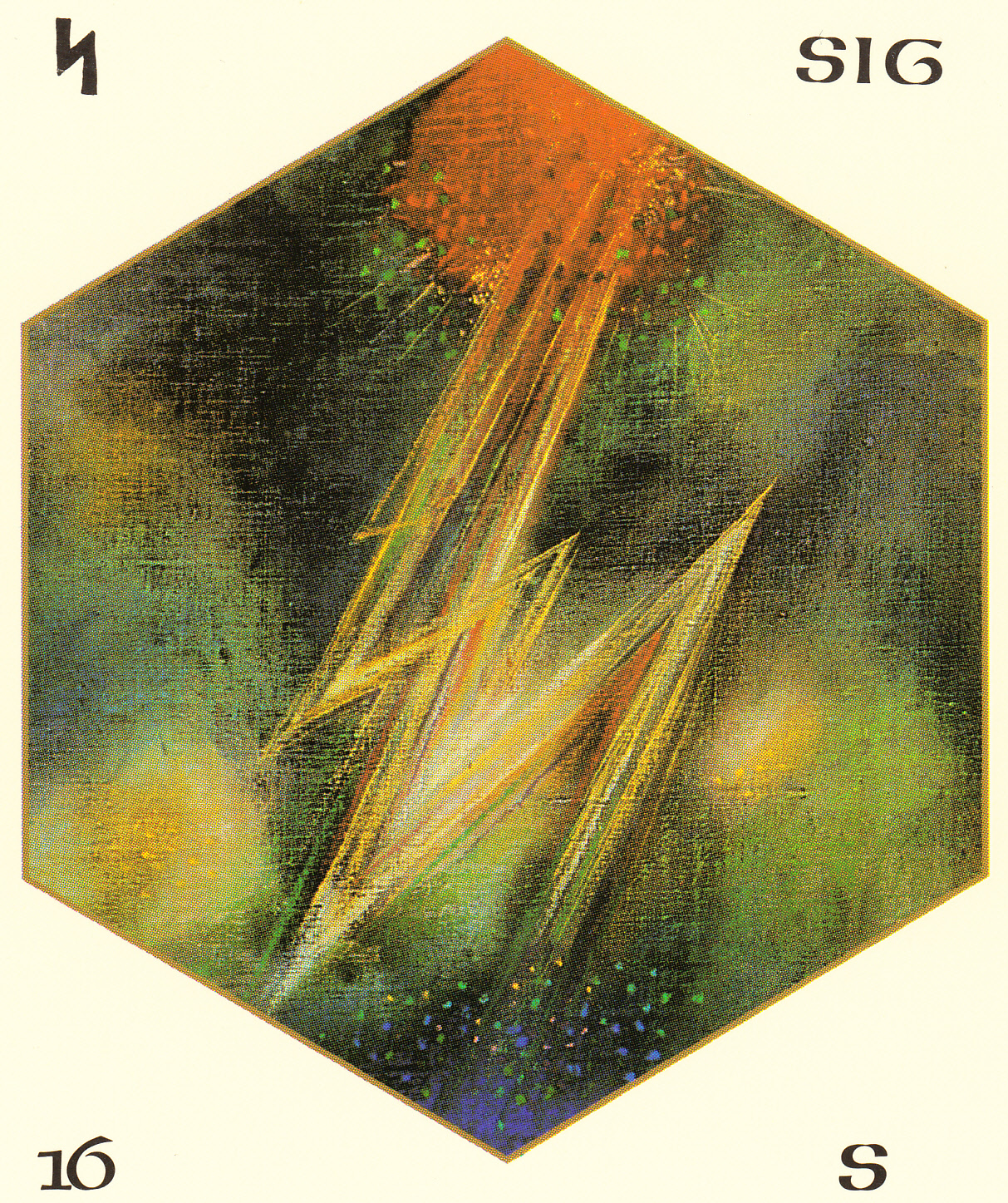
From the Haindl Rune Oracle comes "Sig:"
The Icelandic rune poem describes Sig as a "shining ray and destroyer of ice." In other words, it not only brings clarity, it also paves a smooth road over all the obstacles I've been fighting in an attempt to reach my goal. The rune's form resembles a lightning bolt, a fitting symbol for a breakthrough that leads to success. Yet the card above cautions me that it is not force that will cause this development, but a strength that originates from courage and compassion.

Tuesday, September 17, 2013

Balance and Benevolence

From the Sacred Sites Tarot, the Ten of Pentacles:
This card represents the mythical city of Cibola, a province known as the "Seven Cities of Gold." The Spaniards heard of a place overflowing with riches (in what is New Mexico today), so they organized a large military expedition to find and take possession of it. Obviously it didn't matter that this was the home of the Zuni people. When the Spaniards arrived, they discovered no gold or other treasures, only seven modest pueblos. If I were to write an Aesop-type fable about this place, I would say the wonderful city became ordinary to those whose hearts filled with greed. But perhaps to the Zuni people, their homes were full of riches - just not the kind the Spaniards desired. The Ten of Pentacles reminds me that a place of belonging with basic needs met can often be worth more than any city of gold.

From the Haindl Rune Oracle comes "Feo:"
It is interesting that the Anglo-Saxon rune poem declares wealth (Fe/Feo) "a comfort," but the Old Norse and Icelandic poems describe it as a "source of discord." I think having the "most toys" only makes others want what you have, and then you spend all your time defending your treasure instead of enjoying it. Feo encourages me to use and appreciate the resources available but not try to claim all of them for myself. Balance and benevolence will be my watchwords for the day.

Monday, September 16, 2013

Cup of Kindness

From the Sacred Sites Tarot, the Knight of Cups:
In India is the site of Sarnath (from Saranganath, meaning "Lord of the Deer"), known also as Deer Park. Buddhist legend tells of a bodhisattva (an enlightened being motivated by compassion) who took the shape of a deer and offered his life in return for a doe the king was about to kill. The king was so moved, he created a sanctuary for the deer, which today is Sarnath. It was in this place the Buddha first taught the Dharma, explaining the Four Noble Truths. These Truths defined the underlying dissatisfaction with life, the origin of this suffering, the possibility of release, and the path which would enable such freedom. This card reminds me that all beings suffer - I don't have a monopoly on it. When I realize this concept, it may be easier to offer the cup of kindness to those whom I might originally have thought didn't deserve it.

From the Haindl Rune Oracle comes "Bar/Berkano:"
Bar is associated with the birch tree, a pioneer species, and thus a symbol of growth and renewal. Pioneer species are tough plants that are the first to colonize a disturbed or damaged ecosystem. In combining this idea with the Knight of Cups, there is a sense of healing through kindness.

Sunday, September 15, 2013

A Path of Compassion

From the Sacred Sites Tarot, the Hierophant:
This image depicts the Potala Palace in Lhasa, Tibet. Until 1959, it was the residence of the Dalai Lama. On the Dalai Lama's official website, he lists three commitments that his life is guided by: promoting basic ethical values, fostering inter-religious harmony and the preservation of the peaceful Tibetan Buddhist culture. There's nothing about converting the world and saving souls from eternal damnation. His teachings are offered with an open palm rather than a closed fist. The present Dalai Lama teaches, "If you have a particular faith or religion, that is good. But you can survive without it. We can live without religion and meditation, but we cannot survive without human affection." He and this Hierophant remind me that kindness can be my religion; it needs no other label.

From the Haindl Rune Oracle comes "Is:"
This rune is likened to ice, and in the Anglo-Saxon poem it describes it as "very cold and immeasurably slippery." Is/Ice is an obstacle over which I have no personal control; I must take great care that I don't harm myself or others reacting to it. This card and the one above indicates I should handle my obstacles with compassion instead of allowing anger or pride to trip me up. Tibet was invaded and taken over by China in 1951, and the Dalai Lama fled to India to escape becoming a political prisoner. Tenzin Gyatso, the current Dalai Lama, has spoken out against China and continues to be an advocate for the Tibetan people. Yet he chooses the path of nonviolence to deal with this obstacle, a path that has probably kept many of the Tibetan people safe while they are subjected to the occupation of the Chinese.

Saturday, September 14, 2013

Sacred Trust

This week I'll be using the Sacred Sites Tarot, created by Massimiliano Filadoro and illustrated by Federico Penco; it was published by Lo Scarabeo. This morning's draw is the Ace of Pentacles:
This is an image of Machu Picchu ("old peak"), an estate in Peru built for the Incan emperor Pachacuti about 1450. It was abandoned during the Spanish Conquest a century later and remained hidden except to the locals. American historian Hiram Bingham brought it to international attention in 1911; he also took home hundreds of artifacts from the site. It has taken until November of 2012 for Yale University to return the last of the artifacts taken. Although earthquakes and weather systems threaten the sacred site, the biggest danger to Machu Picchu is the thousands of tourists who visit. In an effort to protect its natural and cultural significance, UNESCO has made it a World Heritage Site. The Ace of Pentacles reminds me I have a sacred duty to take care of the resources I've been entrusted with, whether my health, finances or this lovely earth that is my home.

The other deck I'll be using this week is the Haindl Rune Oracle created by Hermann Haindl and published by U.S. Games. Today's draw is "Yr:"
The Old Norse Rune Poem associates this rune with the yew, a tree known for its longevity. The Icelandic Rune Poem connects it with a bent bow and arrow - a sign of protection. Like the Machu Picchu site above, if I want something to last I must take care of it. And sometimes that means laying down some firm boundaries to protect those things.

Friday, September 13, 2013

Teaching an Old Dog New Tricks

From the Art of Life Tarot comes the Page of Wands (detail from The New Armor by Franz Meyerheim):
It’s never too late to be what you might have become. ~ attributed to George Eliot but actually from Dinah Mulock Craik

I wonder who is teaching whom – perhaps the page knows more about this new-fangled armor than the knight does. But can you teach an old dog new tricks? In the television show Mythbusters, Jamie and Adam took two 7 year old Alaskan malamutes who didn’t know any tricks to test this theory. Although these dogs are known for their stubborn streak, after four days of training both dogs could heel, sit, lie down, stay and shake upon command. I think learning to reinvent yourself probably has more to do with attitude than anything else. If I’m determined to do something new, I probably have a good shot at doing so.

From the Tao Oracle comes the card “The Attraction of Opposites:”
My husband and I are good examples of opposites when it comes to how we do things, yet our values and ethics are very similar. Still, even the simplest things (how to prepare for a trip for instance) underscore our differences. But we’ve remained married all these years because we each understand how we can balance each other out – one’s weakness is the other’s strength. But every now and then, one of us will be convinced of being right while the other is wrong. In combining these two cards, I am encouraged to be flexible in my thinking – a trait that will serve me well if I am learning something new