From the Everyday Enchantment Tarot, the Empress; from the MentorSpirit Cards, 'Understanding:'
Walk into the home of the Empress, and one will be met with a chaotic collection of noise, color, and activity. There are scattered blocks and Play Dough on the counter, a dog and kid running pell-mell through the house, and a box of opened crayons on the floor. Look closer and one will see happy faces and hear laughter; there are bouquets of flowers in many rooms, and the smell of something delicious cooking in the oven. Here there is the freedom to create and be oneself, but mostly there is love. Understanding suggests tolerance because of the ability to comprehend a situation on a deeper level than just the surface. It goes beyond labels and expectations - it is the skill to see things with clarity. So when the baby starts whining, the Empress realizes he's not a brat but teething. When the daughter knocks over her glass of milk, she can discern she is just excited to tell her mom about her day at kindergarten. Yes, there is disorder and at times pandemonium, but there's a whole lot of kindness too.
I use tarot and oracle cards as tools for reflection and contemplation. Rather than divining the future, they are a way for me to look more deeply at the "now."
"The goal isn't to arrive, but to meander, to saunter, to make your life a holy wandering." ~ Rami Shapiro
Monday, May 7, 2018
Sunday, May 6, 2018
Receptive and Respectful
This week I'll be drawing from the Everyday Enchantment Tarot, a set created by Poppy Palin and published by Red Feather. The oracle I'll be using is MentorSpirit, created by Kathy Tyler with Joy Drake and published by InnerLinks Associates. Today's cards are the High Priestess and 'Respect:'
A young Goth gal relaxes in an urban setting, sharing the night with other nocturnal creatures. A puddle beside her reflects the moon but is not the moon itself; it suggests that the heart of spiritual awakening lies in being with our experience rather than intellectual efforts (words are only a 'finger pointing at the moon'). Meditation allows her to watch her own thoughts and feelings without getting caught up in them. Contemplation lets her ponder questions that open previously closed doors in her mind. The knowledge she receives from her look within will be written or drawn in her journals. The Respect card suits this rendition of the High Priestess well - how many people would judge and dismiss her simply because of her looks and youth? Hermann Hesse wrote, "We are sun and moon, dear friend; we are sea and land. It is not our purpose to become each other; it is to recognize each other, to learn to see the other and honor him for what he is: each the other's opposite and complement." No one grows beyond their comfortable cocoons without encountering someone who is different from them. Those who teach us best are generally those who can help us look at other viewpoints and consider ideas that diverge from our own.
Saturday, May 5, 2018
The Demanding Teacher
From the Albano-Waite Tarot, Death; from the Rumi Cards, 'Don't despair:'
From the wise words of Buddhist teacher Judy Lief:
Death is the great interrupter, unreasonable and non-negotiable. No amount of cleverness will make it otherwise.
Death is a strong message, a demanding teacher. In response to death’s message, we could shut down and become more hardened. Or we could open up, and become more free and loving. We could try to avoid its message altogether, but that would take a lot of effort, because death is a persistent teacher.
Death turns out to be the teacher who releases us from fear. It’s the teacher that opens our hearts to a more free-flowing love and appreciation for life and one another. When we get stuck in self-importance and earnestness, death steps in. When we get caught in self-pity, death steps in. When we become complacent and take things for granted, death steps in.
Death spurs us forward with a sense of urgency and puts our preoccupations in perspective. Death lightens our clinging and mocks our pretensions. Death wakes us up. It is our most reliable teacher and most constant companion.
We have all kinds of thoughts about what happens when we die and how we and others should relate with death, but through meditation we learn to recognize thoughts as thoughts. We learn not to mistake these thoughts and ideas about death for direct knowledge or experience. We learn not to believe everything we think or everything we have been told. (Don't despair!)
Friday, May 4, 2018
Expertise
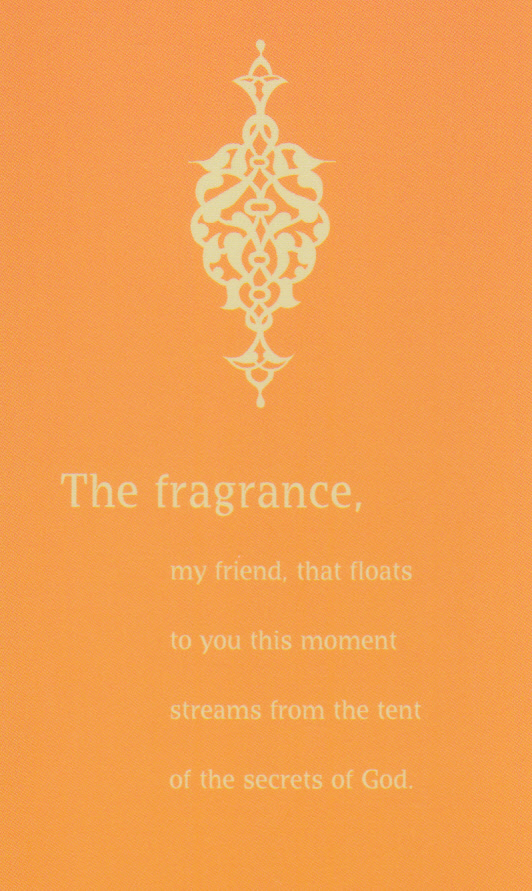
From the Albano-Waite Tarot, the Eight of Pentacles; from the Rumi Cards, 'Fragrance:'
An expert is a man who has made all the mistakes which can be made, in a narrow field.
~Niels Bohr
~Niels Bohr
Why would a person devote years of study and practice to a single area? So they might understand deeply its inner workings and be able to help those who find themselves floundering in a sea of general knowledge without answers. We've all been there with health, home or other issues, holding a riddle that no one could seem to solve. Thank goodness for their commitment and focus that could one day be applied to finding solutions and explanations for others. Rumi's Fragrance card suggests that the Universe is tapping this hardworking fellow on the shoulder. Hopefully, he's not too riveted to notice. It may save him a lot of work fixing a mistake later on down the road.
Thursday, May 3, 2018
Still Standing
From the Albano-Waite Tarot, the Nine of Wands; from the Rumi Cards, 'Fear:'
You know I'm still standing, better than I ever did
Looking like a true survivor, feeling like a little kid.
I'm still standing after all this time,
Picking up the pieces of my life without you on my mind.
~ Elton John
People who've survived hellish childhoods or traumas, those who've been deployed to fight overseas, women who've been battered and abused, those who deal with chronic mental or physical illness, and folks who struggle in poverty are symbolized by this card, particularly if they've managed to survive with a little hope and determination still in them. Yet living in survival mode can create behavior patterns that are hard to shake, even when a person finds a more stable life. Rumi suggests that if love is to thrive, we must cut off the head of fear. Rather than being triggered by past memories and repeating old behavior, we must learn a new way to live that keeps our heart and mind open. Emotional memories can inform and guide us, but only if there is concrete evidence in the present.
Wednesday, May 2, 2018
Rise Up
From the Albano-Waite Tarot, the Six of Pentacles; from the Rumi Cards, 'Awareness:'
The kneeling beggars are symbolic of Western culture today - we believe literally in 'ask and it shall be given' or 'thoughts become things.' It's why books like The Secret have sold millions of copies and why prosperity gospel preachers are so popular. But take an objective look around; those who buy the books or send in donations may briefly have a brighter outlook, but their life situations stay much the same. On the other hand, the authors and preachers are doing quite well financially. Rumi's Awareness card suggests we stop looking for an outside fix for an inside problem. Instead of anesthetizing ourselves with feel-good platitudes, we look with a discerning eye at what will improve our well-being and what won't. A positive attitude may help, but effort and discipline will likely be what show results. In the words of Jesus, " Rise, take up thy bed, and walk."
Tuesday, May 1, 2018
Stirring and Settling
From the Albano-Waite Tarot, the Eight of Cups; from the Rumi Cards, 'Beats its wings with joy:'
I've been a long time leavin'
But I'll be a long time gone.
― Waylon Jennings
The strange grayish-green sky in this Cups card is similar to the color of a sky before a tornado. Often it takes a similar scale of emotional turmoil before we decide to leave relationships, careers or locations. Security of what we know can often keep us in unhealthy places. Yet sometimes it is not the 'other' that is the problem, but our own mindsets and patterns. If that is the case, no geographical cure is going to be successful for long. Rumi's verse speaks of a swan flying away from a body of water in the rain; as it gains distance, it feels joyful and unburdened. It can take time to feel the positive effects of leaving, whether the change is physical or mental. Buddhist author Lodro Rinzler gave a good example of this with a clear glass of water (which represented the mind's natural state of clarity). But then he added a big spoonful of dirt, which symbolized the rush of emotion we feel when an event happens. Left alone (sitting only with the physical sensations of the emotion), the dirt settles and the water becomes clear again. But most of us pick up a spoon (our thoughts) and stir the water, creating mental stories about what is happening. If we can put some distance between those thoughts and the emotion, our mind and heart will be able to find its joy again.
Subscribe to:
Posts (Atom)